Dremio Blog: Open Data Insights
-
 Dremio Blog: Open Data Insights
Data Meaning: Why the Semantic Layer Is the Brain of Agentic Analytics
The investment in the semantic layer pays off not just in agent accuracy but in the reliability of every downstream workflow that depends on agent output.
-
 Dremio Blog: Open Data Insights
Data Unification: The First Pillar of Agentic Analytics
For data engineers building the foundation for agentic analytics, this open-standards approach also means less lock-in risk. The investment in modeling data as Iceberg tables is portable. The catalog is accessible to any Iceberg-compatible engine.
-
 Dremio Blog: Open Data Insights
What Is Agentic Analytics and What Does a True Agentic Analytics Platform Need?
If agentic analytics is on your roadmap, or if you're already building AI applications that need to connect to enterprise data, it's worth auditing where your current platform sits across these three pillars. Most gaps show up fastest when agents start hitting data quality issues, permission errors, or ambiguous schema definitions that a human analyst would have talked their way around.
-
 Dremio Blog: Open Data Insights
The best analytics platforms with native AI integrations in 2026
Discover leading AI-powered data analytics solutions and see how they enhance insights, automation and enterprise decision-making.
-
 Dremio Blog: Open Data Insights
Apache Iceberg vs Delta Lake: Which is right for your lakehouse?
Explore the key differences between Delta Lake and Iceberg, and learn how open data formats enable scalable, AI-ready lakehouse architectures.
-
 Dremio Blog: Open Data Insights
Complete guide on semantic layer: Tools, benefits, and more
Explore how a universal semantic layer can unify your data sources, simplify analytics, and help you achieve better insights.
-
 Dremio Blog: Open Data Insights
13 best unified data management solutions: Guide with comparisons
Explore how data unification works, discover leading, and learn how Dremio can help your enterprise drive better business insights.
-

 Dremio Blog: Open Data Insights
Why Agentic Analytics Requires Federation, Virtualization, and the Lakehouse: How Dremio Delivers
Agentic analytics isn’t a trend. It’s the next phase of how organizations work with data. AI agents need access, speed, and context, across every system your business relies on.
-
 Dremio Blog: Open Data Insights
The Release of Apache Polaris 1.3.0 (Incubating): Improvements to catalog federation, handling non-Apache Iceberg datasets and more
Taken together, these changes show a project that is tightening its foundations while expanding its scope. Polaris 1.3.0 improves visibility through metrics, strengthens governance through externalized policy, and broadens catalog coverage through generic tables.
-
 Dremio Blog: Open Data Insights
Ingesting Data into Apache Iceberg Using Python Tools with Dremio Catalog
In this blog you will learn how to connect each tool to a REST catalog like Dremio Catalog, using bearer tokens and vended credentials to keep your pipelines secure and portable.
-
 Dremio Blog: Open Data Insights
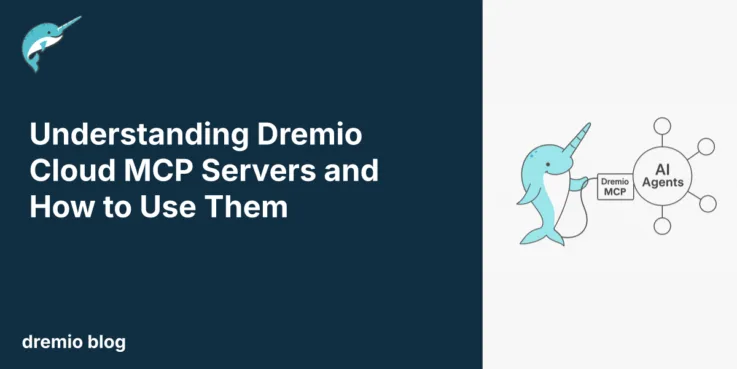
Understanding Dremio Cloud MCP Servers and How to Use Them
You can move unstructured content into Iceberg tables with AI functions. You can use Dremio’s integrated AI agent for natural language exploration. You can connect external assistants through MCP to build multi-step workflows. All these pieces work together. They give data teams a clear path from raw information to AI-powered insights that stay accurate and trustworthy.
-
 Dremio Blog: Open Data Insights
Data management for AI: Tools and best practices
AI data management is the practice of preparing, organizing, governing, and serving enterprise data so it can be used effectively by AI models and agents. It includes collecting data from multiple systems, maintaining high data quality, enforcing governance, and delivering fast, consistent access to that data for training and inference.
-
 Dremio Blog: Open Data Insights
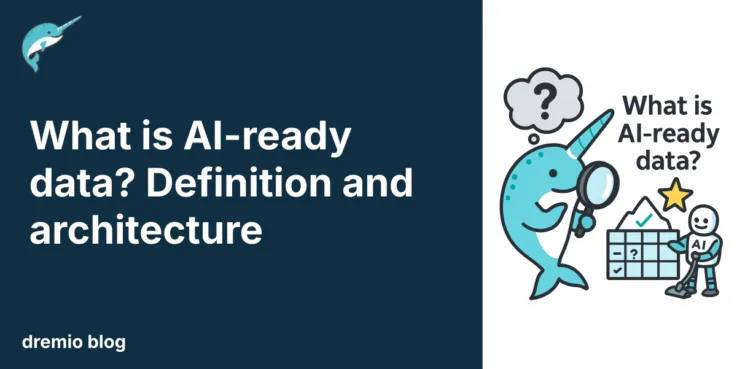
What is AI-ready data? Definition and architecture
AI-ready data is structured, governed, and accessible in a way that supports machine learning, large language models (LLMs), and real-time intelligent agents. Unlike traditional analytics data, it’s not just clean, it’s optimized for rapid, automated decision-making at scale. AI-ready data supports diverse formats, is accessible without ETL, and maintains the context required to train and operate intelligent systems.
-
 Dremio Blog: Open Data Insights
What’s New in Apache Polaris 1.2.0: Fine-Grained Access, Event Persistence, and Better Federation
Apache Polaris 1.2.0 continues to make the case for a fully open, production-grade Iceberg catalog. These changes reflect real-world needs: better control, stronger security, broader compatibility, and early hooks for observability. As Iceberg adoption grows, Polaris is becoming the default choice for teams who want to avoid vendor lock-in while building modern lakehouse infrastructure. Whether you’re using Dremio Catalog or deploying Polaris yourself, this release brings features that support scale, safety, and flexibility.
-
 Dremio Blog: Open Data Insights
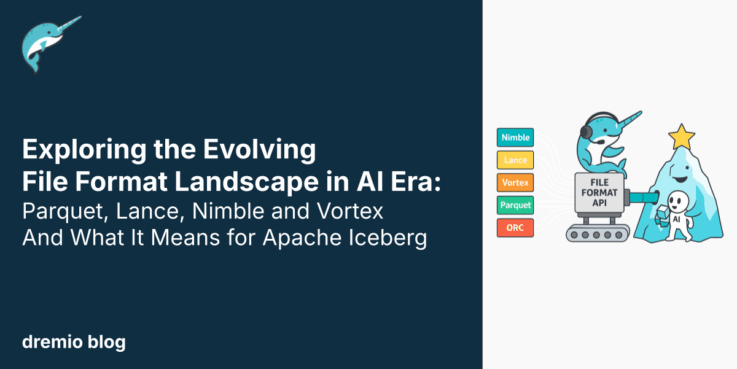
Exploring the Evolving File Format Landscape in AI Era: Parquet, Lance, Nimble and Vortex And What It Means for Apache Iceberg
Formats like Lance, Nimble, and Vortex show that innovation is accelerating. Each one introduces new ideas about how to structure, index, and access data. But none of them exist in isolation. They need to integrate with engines, catalogs, and governance layers to be truly useful.
- 1
- 2
- 3
- …
- 12
- Next Page »